
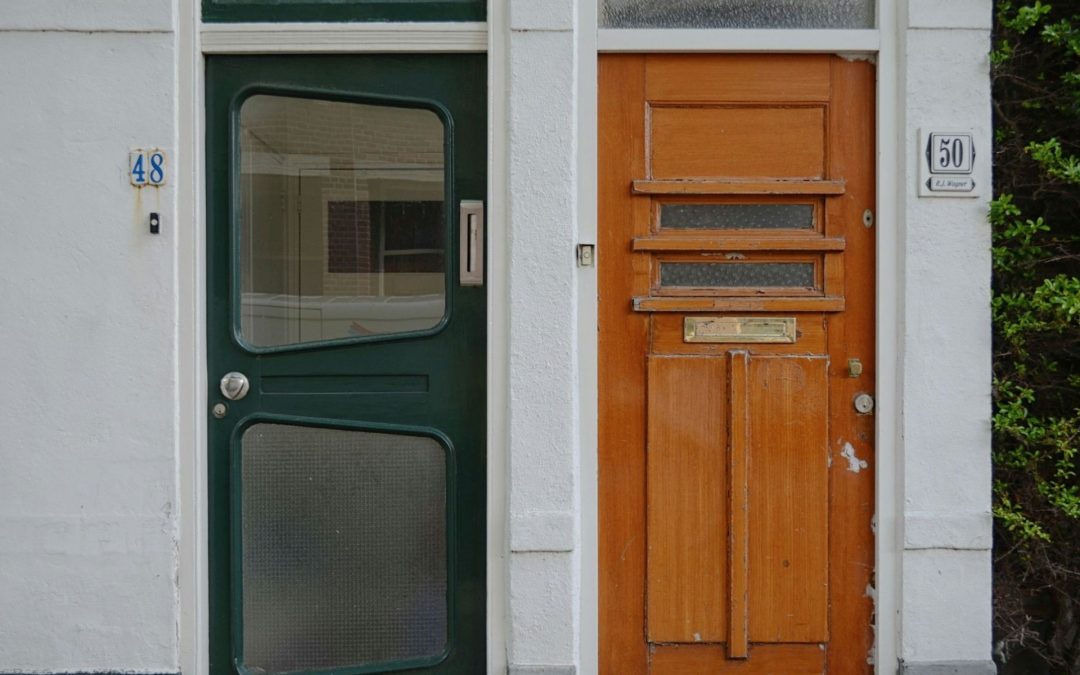
Duplexes, dual occupancies, walk-up apartments and small townhouse clusters sit in an awkward middle ground. They have more neighbours and shared boundaries than a freestanding house, but they rarely get the fully enclosed lobbies and mechanical systems of larger apartment buildings. Front doors often open directly to the street, to external stairs or to open-air galleries.
In these projects, the front door has to manage security, privacy and ventilation in close proximity to other people’s entries. A standard door plus security screen can quickly make a small shared frontage look cluttered and make circulation feel narrow.
This article looks at how to use multi-function entry doors in smaller multi-residential projects so that individual homes can breathe and feel secure without turning common areas into a forest of screens. For the bigger picture on why a multi-function door is worth considering at all, see the main guide to architect designed, secure, ventilated front doors. For façade thinking on individual homes, the design principles in ventilated front entries that do not rely on bolt-on screens still apply; here we add the layer of shared streetscapes and common property.
Why small multi-res entries often feel cramped and messy
When several front doors share a short run of street or external corridor, the usual issues quickly multiply
- Every extra leaf and handle projects into limited circulation space
- Different security screen selections create a visually noisy frontage
- Hallways and stairs can feel darker as layers of mesh and frames build up
- Residents are reluctant to open front doors for ventilation because neighbours pass close by
The result is a collection of entries that feel cluttered and defensive, even when the architecture on paper is simple. Residents retreat behind solid doors, and the front of the building becomes something to move through quickly, not a comfortable part of daily life.
Our architect overview on designing front doors your clients love living with, not screens they tolerate describes this in detached housing. In multi-res, it is amplified by repetition and proximity.
Where multi-function entry doors make sense in multi-res projects
Multi-function doors are not suited to all multi-res contexts. They are most useful where each dwelling’s front door
- Opens directly to the outside, an open-air gallery or an external stair
- Can legitimately be part of that dwelling’s natural ventilation strategy
- Is not forming part of a fire-isolated, pressurised or mechanically controlled corridor
Typical examples include
- Dual occupancies and duplexes with separate entries to the street
- Small townhouse rows with individual doors onto a shared forecourt
- Walk-up apartments where each unit opens to an external breezeway or balcony
In these settings, a multi-function door can
- Replace a solid door plus separate security screen with one leaf
- Allow each dwelling to use the front door as a secure-ventilation opening
- Reduce visual clutter in shared areas by eliminating mismatched screens
Where front doors open onto internal, conditioned corridors or fire-isolated stairs, you will usually prioritise fire, smoke and acoustic performance over ventilation at that threshold. In those cases, keep the multi-function concept for external openings that genuinely form part of the dwelling’s airflow path, as discussed in how ventilated front entries behave in Australian homes.
Keeping circulation clear and safe
In small multi-res schemes, circulation width and clearances are often tightly controlled. Replacing two leaves with one has clear practical benefits.
A multi-function door helps you
- Remove the extra projection of a security screen into a gallery or stair landing
- Reduce the number of separate swing arcs people have to navigate with prams, trolleys or mobility aids
- Simplify hardware and handles at hand height along narrow walkways
When sketching, check
- The clear width of walkways and landings with all doors shut and with one door open
- How far handles and hardware project into circulation
- Whether two neighbours can comfortably pass each other while one is using their front door
The universal design concepts in helping older Australians feel steady and confident at their front door are particularly relevant here. In shared circulation, a small improvement in one dwelling’s entry can benefit everyone who uses the gallery or stair.
Making a tidy, consistent shared elevation
One of the biggest advantages of multi-function doors in small clusters is visual consistency. In many townhouse and duplex developments, inconsistent security screens undo the architect’s original composition.
With a multi-function approach, you can
- Specify a consistent door type and colour across a row or cluster
- Use the glazed and mesh portions as deliberate elements in the elevation rather than patchy add-ons
- Coordinate house numbers, lighting and hardware so the shared frontage feels intentional
You can still tune individual doors where needed
- Clear glass and more open mesh to quieter side streets
- Translucent glass or slightly different detailing to busier frontages, applying the logic from front doors for homes on busy roads
By starting with a standard multi-function door family in your design, you reduce the likelihood of ad hoc security screen choices later.
Balancing privacy between neighbours and the street
In small multi-res projects, entries are often close to both neighbours and public space. People want airflow, but they do not necessarily want to see directly into each other’s homes.
A multi-function door gives you more control because you can separate
- Door locked state (managed by the main lock)
- Airflow (managed by sliding the internal glass)
- Visibility (managed by glass type and the position of the glazed section)
In your design, think about
- Sightlines from opposite doors or windows when the glass is open
- Whether people walking past can see straight down a hall into living areas
- How much interaction residents want at the threshold in that particular project
You can tune each door using the strategies discussed in front doors for busy roads
- Clear glass where connection and passive surveillance are desirable
- Translucent glass where privacy is more important, while still allowing ventilation through the mesh
This way, residents can use the secure-ventilation mode without feeling like they are putting their homes on display to neighbours or the street.
Coordinating with bodies corporate and common property
In many small multi-residential projects, anything visible from the street is ultimately controlled by an owners corporation or strata body. That has two implications for multi-function doors
- Changes after completion can be difficult if each owner chooses their own approach
- Early consensus around a single door type leads to more coherent long-term outcomes
As the architect, you can
- Document a standard multi-function door specification for all primary entries, with clear notes about glazing and hardware options
- Provide simple language that owners corporations can use later if replacement doors are needed
- Coordinate with legal and client teams so that the door type and finishes are captured in strata or guidelines, not just in your drawings
This reduces the risk that, a few years after completion, mismatched security screens begin to appear over some front doors, undermining the work you did on the façade.
Fire, egress and acoustic considerations
Front doors in multi-residential projects often carry additional responsibilities
- They may form part of fire and egress paths
- They may need to meet specific acoustic targets between dwellings and the street or common areas
Multi-function doors do not override these requirements; they have to sit within them. At concept stage
- Treat all fire, smoke and egress conditions as fixed constraints
- Use multi-function doors where they can operate inside those constraints as a simple door that also offers secure ventilation
- Involve a fire engineer early if you are unsure whether any special closers, seals or ratings are needed at the entry
For acoustic performance, you can often
- Use solid, well-sealed leaves and appropriate glazing in the multi-function door
- Rely on the secure-ventilation mode primarily at times of day when external noise is lower
The detailing strategies in detailing multi-function entry doors in wall systems help you design jambs, thresholds and seals that support these performance requirements.
Applying retrofit thinking to ageing multi-res stock
Many duplexes and walk-up apartments you will see in practice are decades old. Entries may be cluttered with improvised screens, mailboxes and barriers. Replacing standard front doors with multi-function doors can be part of a carefully scoped retrofit.
You can adapt the process in retrofitting Air Flow Doors into existing homes to common property
- Diagnose what is not working at current entries: light, airflow, perceived safety, clutter in circulation
- Propose a standard multi-function front door type for all units, coordinated with a modest façade and corridor refresh
- Test thresholds, landings and clearances against the universal design ideas in helping older Australians feel steady and confident at their front door
Handled carefully, a front-door upgrade across a small block can significantly improve comfort and perceived safety without major structural changes.
A simple framework for small multi-res projects
On your next duplex, dual occupancy, townhouse cluster or walk-up, you can decide whether to use multi-function entry doors by running through a short framework
- Context
- Do front doors open to external space where secure ventilation makes sense, rather than into conditioned corridors
- People
- Will residents of different ages and abilities find a single multi-function door easier to live with than a door plus screen
- Place
- Will consistent multi-function doors improve or clutter the shared streetscape, given your façade concept
If the answer looks positive on all three, you can lean on
- Designing front doors your clients love living with, not screens they tolerate for the overall rationale
- Ventilated front entries that do not rely on bolt-on screens for façade composition
- Helping older Australians feel steady and confident at their front door for human-centred detailing
- Detailing multi-function entry doors in wall systems for technical sections
- Retrofitting Air Flow Doors into existing homes when you are working with existing small multi-res stock
This gives you a coherent way to specify front doors in compact, shared settings that respect neighbours, support everyday life and still let each dwelling breathe.